• /
  • Blog

Website Bandwidth vs. Data Transfer: The Dedicated Server Guide

Confused by hosting specs? We break down the critical difference between Port Speed (1Gbps) and Monthly Transfer limits so you can stop overpaying for "Unlimited" lies.

The Great Bandwidth Confusion

In the world of web hosting, terms like "Bandwidth," "Data Transfer," and "Throughput" are often thrown around interchangeably. If you are coming from a Shared Hosting background, you have likely seen plans advertising "Unlimited Bandwidth."

Here is the hard truth: In the professional Dedicated Server world, "Unlimited" without context is a myth. To build a high-performance infrastructure, you need to understand the two distinct metrics that actually matter.

Bandwidth vs. Data Transfer: The Pipe Analogy

To visualize the difference, imagine your server's internet connection is a water pipe. This is the easiest way to understand why a "fast" server might still be slow if the metrics are wrong.

  • Bandwidth (Port Speed): This is the width of the pipe. It determines how much water (data) can flow through at one specific second. In dedicated hosting, this is your Uplink speed, measured in Mbps or Gbps (e.g., 1Gbps Uplink).
  • Data Transfer (Throughput): This is the total amount of water that flows through that pipe over a period of time (usually a month). This is measured in GB or TB (e.g., 10TB Data Limit).

Why does this distinction matter?
You might have 10TB of Data Transfer allowed (lots of water capacity), but if your Port Speed is only 100Mbps (a very thin pipe), your website will crash when 1,000 users try to access it simultaneously. The pipe simply gets clogged.

Unlimited vs. Unmetered: Know the Difference

Many buyers get confused because these two words sound similar. But in the server world, they are opposites.

At iRexta, we sell Unmetered Bare Metal. This means if you buy a 1Gbps port, you can push 1Gbps traffic every second of the month without paying a penny extra. No hidden caps.

How to Calculate Your Real Bandwidth Needs

Don't guess. Use this formula to find your required Throughput:

(Average Page Size x Concurrent Users) = Required Speed

Real World Example:

  • Your streaming app has a 5 Mbps bitrate.
  • You have 500 concurrent viewers.
  • Math: 5 Mbps x 500 = 2,500 Mbps (2.5 Gbps).

💡 The "Middle Ground" Solution (LACP):

In the example above, you need 2.5 Gbps. A standard 1Gbps server is too slow, but jumping to a 10Gbps server might be over your budget.

The iRexta Solution: You don't always need to overpay. We can configure LACP (Link Aggregation) to bond multiple 1Gbps ports together (e.g., 4x 1Gbps = 4Gbps Uplink). This is a smart, cost-effective way to scale.

Pro Tip: Ingress vs. Egress & Private Networking

Advanced server admins know that not all bandwidth costs money. Understanding traffic direction can save you thousands.

1. Ingress is Often Free

Ingress is traffic coming INTO your server (e.g., uploading backups to your server). Egress is traffic going OUT (users viewing your site). At iRexta, we typically provide unmetered Ingress. If you use your server for backups or data ingestion, this is a huge cost saver.

2. Public vs. Private Bandwidth

Don't waste your expensive Public Bandwidth on internal tasks.

  • Public Network: Connects to the internet. Use this only for user traffic.
  • Private Network (VLAN): Connects your servers together (e.g., Web Server <-> Database Server). This traffic never leaves the datacenter.

iRexta Advantage: We provide Free, Unmetered 1Gbps/10Gbps Private Networking. Ensure your database backups and internal syncs run on the Private Interface (eth1) to keep your Public Interface (eth0) free for customers.

Shared vs. Dedicated: The Breakdown

Still unsure if you need a dedicated port? Here is a side-by-side comparison of how bandwidth works in different environments.

Conclusion: Choose Power, Not Buzzwords

Your website's performance hinges on the quality of your network uplink. Don't let a "bottleneck" port ruin your user experience. "Unlimited" shared hosting might be cheap, but it costs you users when it matters most.

Whether you need a 10TB package for standard web hosting or a 10Gbps Unmetered Port for intense streaming, iRexta provides the raw, isolated power you need to scale without limits.

Ready to upgrade your speed? Explore iRexta's High-Bandwidth Dedicated Servers

Frequently Asked Questions about Server Bandwidth

What is the difference between Bandwidth and Data Transfer?
Bandwidth (Port Speed) is the width of the pipe, measuring how much data can flow at one specific second (e.g., 1Gbps). Data Transfer is the total amount of water that flows through that pipe over a month (e.g., 10TB).
Does iRexta offer Unmetered Bandwidth?
Yes. Most of our Unmetered Dedicated Servers come with guaranteed options on 1Gbps or 10Gbps ports. This means you are not capped by a monthly data limit, which is ideal for high-traffic applications.
Is high bandwidth important for Gaming Servers?
Absolutely. For Gaming Servers, low latency and network stability are critical. Having a dedicated 1Gbps or 10Gbps port ensures that your game logic (tick rate) isn't throttled by network congestion, providing a lag-free experience for players.
Do I need a 10Gbps Uplink?
You typically need a 10Gbps Dedicated Server if you run high-traffic applications like video streaming, large file distribution, or enterprise-grade Storage Servers where thousands of users access data simultaneously.
Is my bandwidth protected from attacks?
Yes. Bandwidth spikes can sometimes be malicious attacks. All iRexta servers come with robust protection. For mission-critical infrastructure, we recommend our Anti-DDoS Dedicated Servers to filter out bad traffic without affecting your legitimate bandwidth usage.
Can I upgrade my Port Speed later?
Yes, scalability is seamless. You can start with a 1Gbps port and upgrade to 20Gbps, 40Gbps, or even 100Gbps as your traffic grows. This is perfect for expanding GPU Servers running AI workloads or heavy media streaming.

Recent Topics for you

Real-Time Deepfake Detection Infrastructure: Why Cloud VMs Drop Frames and Dedicated GPUs Win

Real-Time Deepfake Detection Infrastructure: Why Cloud VMs Drop Frames and Dedicated GPUs Win

Is your deepfake defense missing critical AI glitches? Discover how hypervisor latency causes dropped frames, and why security teams trust Dedicated Bare Metal GPUs for Zero-Trust video analysis.

The Silent App Killer: IOPS vs. Throughput

The Silent App Killer: IOPS vs. Throughput

You doubled your RAM and CPU, but your database is still crawling. Stop blaming your code. Here is the deep science of storage metrics and how to escape the "Provisioned IOPS" cloud trap.

DBaaS vs. Dedicated Servers: The Real Cost of "Convenience"

DBaaS vs. Dedicated Servers: The Real Cost of "Convenience"

Why high-growth startups are moving their databases back to Bare Metal to save money, boost IOPS, and escape the "Cloud Trap".

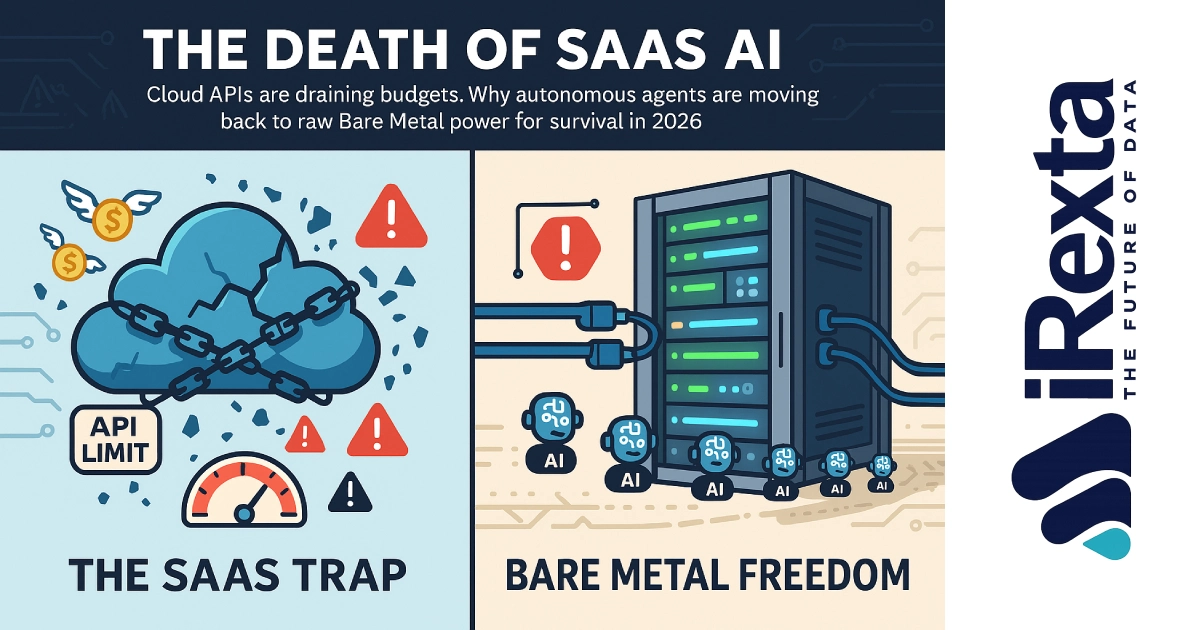
The Death of SaaS: Why AI Agents Are Moving Back to Bare Metal

The Death of SaaS: Why AI Agents Are Moving Back to Bare Metal

AI APIs and Cloud GPUs are draining budgets. Discover why the tech industry is shifting toward Bare Metal Dedicated Servers for running AI Agents in 2026.

Website Bandwidth vs. Data Transfer: The Dedicated Server Guide

Website Bandwidth vs. Data Transfer: The Dedicated Server Guide

Confused by hosting specs? We break down the critical difference between Port Speed (1Gbps) and Monthly Transfer limits so you can stop overpaying for "Unlimited" lies.

VMware is Dead? Switch to Proxmox Bare Metal

VMware is Dead? Switch to Proxmox Bare Metal

Broadcom just broke the contract of trust. Learn why sysadmins are fleeing ESXi for Proxmox, KVM, and ZFS on iRexta Bare Metal.

Why Gaming Companies Are Switching to Bare Metal Servers

Why Gaming Companies Are Switching to Bare Metal Servers

Lag kills games. Discover why top gaming studios choose Bare Metal over Cloud for higher Tick Rates, lower latency, and zero Noisy Neighbors.

TLS vs. SSL: Key Differences & Why You Must Upgrade (2025 Guide)

TLS vs. SSL: Key Differences & Why You Must Upgrade (2025 Guide)

Confused about TLS vs. SSL? Our definitive guide breaks down the critical differences in security, encryption, and performance.

RAID 50 vs RAID 60: Which RAID Configuration Is Best for Your Server Needs?

RAID 50 vs RAID 60: Which RAID Configuration Is Best for Your Server Needs?

Confused between RAID 50 and RAID 60? Discover the key differences, performance comparisons, and best use cases. Learn which configuration suits your server setup in Denver or across Colorado.

Private Networking for Bare Metal Servers

Private Networking for Bare Metal Servers

Discover how private networking for bare metal servers boosts security, reduces latency, and saves bandwidth costs. Learn benefits, use cases, and how it works.

What Are the Risks of Not Having a Dedicated IP Address?

What Are the Risks of Not Having a Dedicated IP Address?

In today's interconnected digital landscape, a dedicated IP address plays a crucial role in ensuring secure, stable, and high-performance access to online services.

What Is the Difference Between SoftRAID and HardRAID? Which One Is Better?

What Is the Difference Between SoftRAID and HardRAID? Which One Is Better?

RAID, short for Redundant Array of Independent Disks, is a foundational technology used in data storage to improve performance, enhance fault tolerance, and ensure high availability.

1