• /
  • Blog

DBaaS vs. Dedicated Servers: The Real Cost of "Convenience"

Why high-growth startups are moving their databases back to Bare Metal to save money, boost IOPS, and escape the "Cloud Trap".

The "Honey Trap" of DBaaS

"Database as a Service (DBaaS) is the future. Just click a button, and you have a database!"

This is the pitch every major cloud provider (AWS, DigitalOcean, Scaleway) sells you. In the beginning, it feels like magic. You don’t need a Database Administrator (DBA), you don't worry about hardware, and complex tasks like automated backups are handled for you.

But what they don't tell you is the Convenience Tax. As your app grows and your database size increases, your $50/month DBaaS bill skyrockets to $5,000/month or more. You quickly realize you are paying premium enterprise prices for shared, throttled hardware.

At iRexta, we believe in a "Clients First" approach. That means telling you the complete truth about infrastructure costs—including the human costs. Here is why moving to a Dedicated Server might be the most profitable decision your engineering team makes this year.

1. The Price Illusion: Numbers Don't Lie

Let’s look at the hard data. DBaaS providers charge you separately for vCPU, RAM, storage limits, and the most dangerous metric of all—Egress Fees (Data Transfer out).
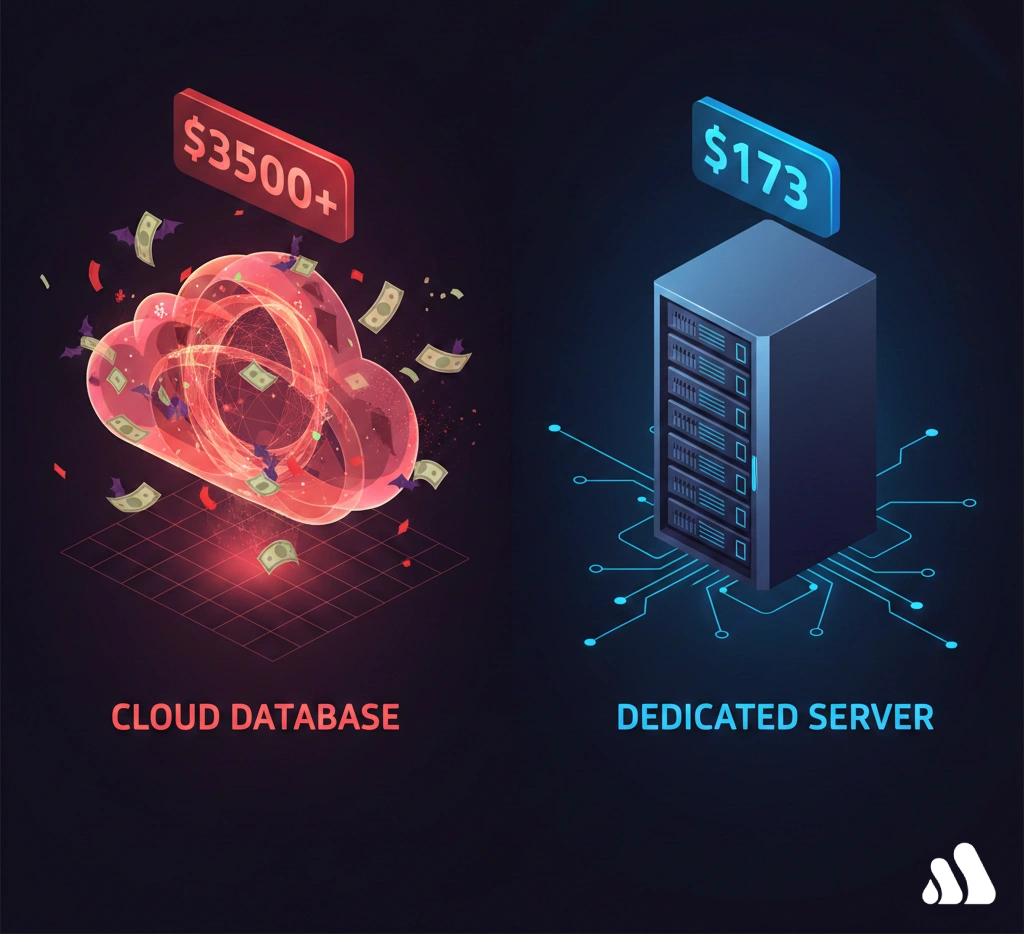
Real-World Hardware Comparison: 128GB RAM Database

If you need a database server with 128GB RAM and 24 Cores to handle heavy queries:

  • Major Cloud DBaaS (e.g., AWS RDS / Google Cloud SQL): Estimated $3,500+ per month (plus Egress fees).
  • iRexta Dedicated Storage Server: Just $173 per month.

The Specs you get for $173 at iRexta:
🚀 CPU: 2x Intel Xeon E5-2650L v3 (24 Cores / 48 Threads)
🧠 RAM: 128GB DDR4
💾 Storage: 400GB SSD (Easily Expandable via NVMe)
🌐 Bandwidth: 1000Mbps Unmetered (Zero Egress Fees)

Cost comparison between expensive Cloud DBaaS and affordable iRexta Dedicated Storage Server
Don't pay the 'Convenience Tax'. While Cloud DBaaS costs scale with your data, iRexta Bare Metal offers predictable, fixed pricing that saves you up to 80% as you grow.

2. The Elephant in the Room: The Cost of a DBA

Let’s be brutally honest. Cloud providers offer amazing features like automated backups, point-in-time recovery, and 1-click scaling. Managing a Bare Metal database is not a simple 2-hour job. You need an experienced Database Administrator (DBA) or a senior DevOps engineer to secure and maintain it.

So, when does moving to Bare Metal make sense? It comes down to the Scale Tipping Point.

  • If your Cloud DBaaS bill is $500/month, stay in the cloud. Hiring a DBA will cost you more than the infrastructure.
  • But if your Cloud DBaaS bill hits $15,000/month... Hiring a top-tier DBA for $6,000/month and renting two high-end iRexta Dedicated Servers for $1,500/month still saves your business $7,500 every single month ($90,000/year).

At scale, the "human cost" of a dedicated DBA is far cheaper than the 500% markup fees charged by cloud providers. Plus, your DBA will optimize your slow queries—something the cloud provider will never do for you!
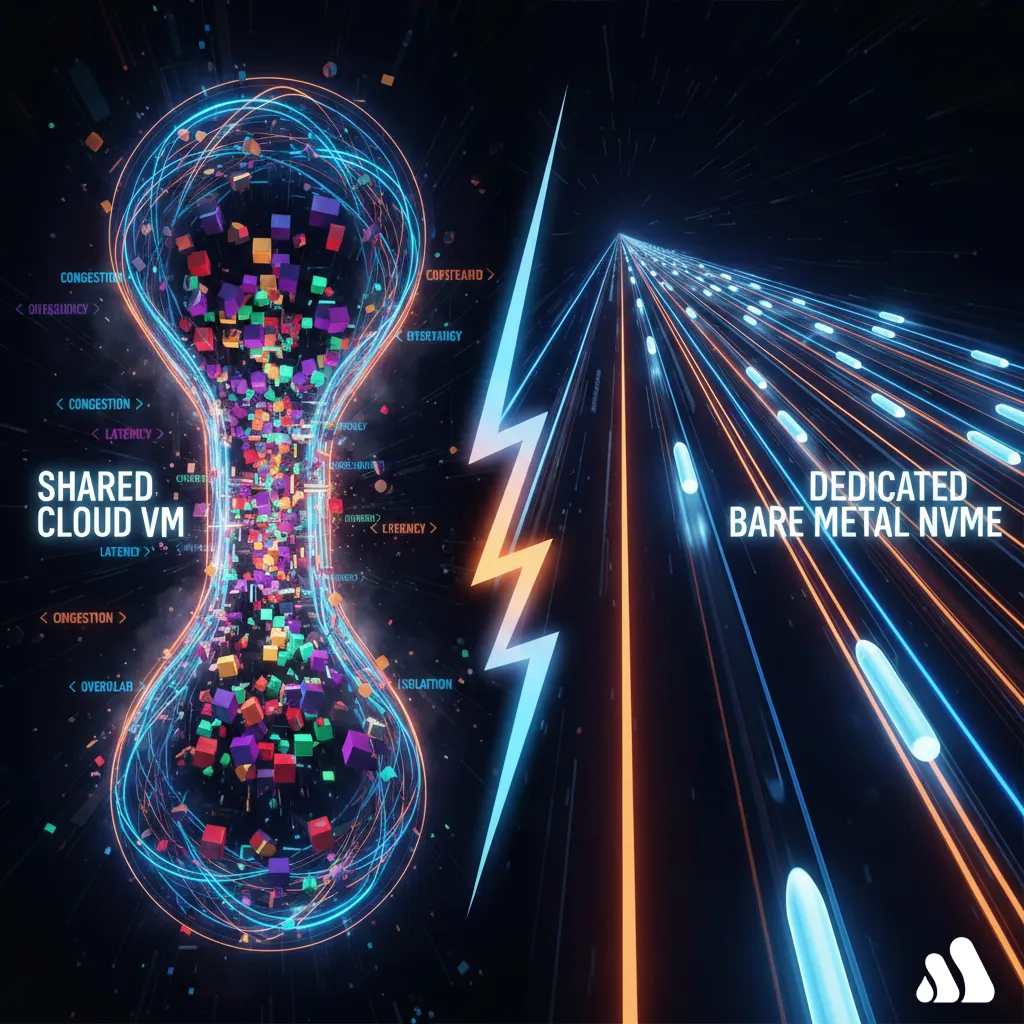
Visual representation of Cloud noisy neighbor latency vs dedicated bare metal storage performance
Escape the data traffic jam. Move your database from a shared cloud environment to a private highway of dedicated NVMe storage for lightning-fast query response times.

3. The "Noisy Neighbor" & Storage Latency

In a DBaaS environment, your database is running on a Virtual Machine (VM). You are sharing the physical server's CPU and Disk I/O with other customers.

The Hidden Latency of Cloud Storage: Most DBaaS providers use Network-Attached Storage (like AWS EBS). Every time your database reads/writes, the data travels over a network cable. On an iRexta Dedicated Server, your database runs on Local PCIe NVMe SSDs physically attached to the motherboard, reducing query latency from milliseconds to microseconds.

The iRexta Bare Metal Difference: With our servers, you get Dedicated Resources. No I/O throttling, no shared network storage bottlenecks. Need a monster DB? Check out our 2x AMD EPYC 9354 server with 384GB DDR5 RAM and 23TB of NVMe Storage for just $1727/mo. Try finding that raw, unthrottled power in the cloud for under $15,000!

4. High Availability & Disaster Recovery

Cloud DBaaS provides Automated Failover at a massive premium. Replicating this on Bare Metal is highly effective, but it requires proper architecture.

  • Data Redundancy (RAID Protection): Data safety is mandatory. Unlike cloud volumes, iRexta offers flexible RAID options:
    • Free Software RAID: We provide Free Software RAID (0, 1, 5, 10) on all our servers. This ensures your database stays online even if a drive fails, at no extra cost.
    • Hardware RAID (Model Specific): Dedicated Hardware RAID controllers are available on select server models as a configurable add-on for those needing extra hardware-level offloading.
  • Automated Failover: By renting two iRexta servers and connecting them via our Free 10Gbps Private Network, your DBA can set up active-passive replication using tools like Patroni (for PostgreSQL) or ClusterControl to achieve Cloud-like automatic failover.
  • Disaster Recovery (DR): You maintain full control. You can script automated encrypted backups directly to an affordable iRexta Backup Server or an external S3 bucket, ensuring data safety across different geographic locations.

Conclusion: Own Your Performance

DBaaS is fantastic for prototyping and small applications. But for production workloads at scale, it becomes a financial and technical bottleneck.

At iRexta, we put Clients First. We provide the raw power—Enterprise NVMe storage, massive RAM, and unmetered bandwidth—at a fair, transparent price. You bring the talent (your DBA), and we will bring the performance.

Ready to escape the cloud trap? View our High-Storage Dedicated Servers.
DBaaS vs. Dedicated: FAQ

What is Database Vendor Lock-in?
Cloud providers make it free to upload data (Ingress) but charge massive fees to download it (Egress). Once your DBaaS grows to Terabytes, moving away becomes too expensive. With an iRexta Dedicated Server, you have unmetered bandwidth and full root access, ensuring zero vendor lock-in.
Is Dedicated Hosting harder than DBaaS?
Yes, it requires system administration skills. While DBaaS handles updates and backups automatically, a Dedicated Server requires a DBA or DevOps engineer to configure and maintain the database, set up replication, and manage security. The trade-off is massive cost savings at scale and complete control over performance.
Does iRexta provide RAID for free?
Yes, Software RAID (0, 1, 5, 10) is completely free and available on every iRexta server. Hardware RAID is an optional feature available only on specific server models and may incur additional costs depending on the configuration.
Can I scale on a Dedicated Server?
Yes. You can scale vertically (upgrade RAM/CPU/NVMe) or horizontally by clustering multiple iRexta servers together using our free, high-speed Private Networking, which offers zero-latency internal communication.
Is Bare Metal secure for databases?
When properly configured by a professional, it is often more secure. You are not on a shared hypervisor network with thousands of other users. You have full physical isolation, can configure custom strict firewalls, and establish private VLANs.

Recent Topics for you

Real-Time Deepfake Detection Infrastructure: Why Cloud VMs Drop Frames and Dedicated GPUs Win

Real-Time Deepfake Detection Infrastructure: Why Cloud VMs Drop Frames and Dedicated GPUs Win

Is your deepfake defense missing critical AI glitches? Discover how hypervisor latency causes dropped frames, and why security teams trust Dedicated Bare Metal GPUs for Zero-Trust video analysis.

The Silent App Killer: IOPS vs. Throughput

The Silent App Killer: IOPS vs. Throughput

You doubled your RAM and CPU, but your database is still crawling. Stop blaming your code. Here is the deep science of storage metrics and how to escape the "Provisioned IOPS" cloud trap.

DBaaS vs. Dedicated Servers: The Real Cost of "Convenience"

DBaaS vs. Dedicated Servers: The Real Cost of "Convenience"

Why high-growth startups are moving their databases back to Bare Metal to save money, boost IOPS, and escape the "Cloud Trap".

The Death of SaaS: Why AI Agents Are Moving Back to Bare Metal

The Death of SaaS: Why AI Agents Are Moving Back to Bare Metal

AI APIs and Cloud GPUs are draining budgets. Discover why the tech industry is shifting toward Bare Metal Dedicated Servers for running AI Agents in 2026.

Website Bandwidth vs. Data Transfer: The Dedicated Server Guide

Website Bandwidth vs. Data Transfer: The Dedicated Server Guide

Confused by hosting specs? We break down the critical difference between Port Speed (1Gbps) and Monthly Transfer limits so you can stop overpaying for "Unlimited" lies.

VMware is Dead? Switch to Proxmox Bare Metal

VMware is Dead? Switch to Proxmox Bare Metal

Broadcom just broke the contract of trust. Learn why sysadmins are fleeing ESXi for Proxmox, KVM, and ZFS on iRexta Bare Metal.

Why Gaming Companies Are Switching to Bare Metal Servers

Why Gaming Companies Are Switching to Bare Metal Servers

Lag kills games. Discover why top gaming studios choose Bare Metal over Cloud for higher Tick Rates, lower latency, and zero Noisy Neighbors.

TLS vs. SSL: Key Differences & Why You Must Upgrade (2025 Guide)

TLS vs. SSL: Key Differences & Why You Must Upgrade (2025 Guide)

Confused about TLS vs. SSL? Our definitive guide breaks down the critical differences in security, encryption, and performance.

RAID 50 vs RAID 60: Which RAID Configuration Is Best for Your Server Needs?

RAID 50 vs RAID 60: Which RAID Configuration Is Best for Your Server Needs?

Confused between RAID 50 and RAID 60? Discover the key differences, performance comparisons, and best use cases. Learn which configuration suits your server setup in Denver or across Colorado.

Private Networking for Bare Metal Servers

Private Networking for Bare Metal Servers

Discover how private networking for bare metal servers boosts security, reduces latency, and saves bandwidth costs. Learn benefits, use cases, and how it works.

What Are the Risks of Not Having a Dedicated IP Address?

What Are the Risks of Not Having a Dedicated IP Address?

In today's interconnected digital landscape, a dedicated IP address plays a crucial role in ensuring secure, stable, and high-performance access to online services.

What Is the Difference Between SoftRAID and HardRAID? Which One Is Better?

What Is the Difference Between SoftRAID and HardRAID? Which One Is Better?

RAID, short for Redundant Array of Independent Disks, is a foundational technology used in data storage to improve performance, enhance fault tolerance, and ensure high availability.

1