• /
  • Blog

The Death of SaaS: Why AI Agents Are Moving Back to Bare Metal

API bills and Cloud GPU hourly rates are draining startups. Here is the unvarnished truth about why the industry is rapidly moving AI workloads back to dedicated hardware.

The Scaling Trap of Cloud AI

In the early days of AI, using an API or renting a Cloud GPU by the hour made sense. It was the "testing phase." But as you scale to thousands of daily tasks, you hit a mathematical reality: Renting intelligence severely limits your profit margins.

Venture capital firm Andreessen Horowitz (a16z) previously coined the "Cloud Paradox"—noting that while cloud computing is great for starting a business, it heavily penalizes scaling it. With the rise of Autonomous AI Agents, this paradox has multiplied by a factor of ten. The era of "AI-as-a-Service" is fundamentally shifting toward AI Repatriation (bringing infrastructure in-house).

The Fundamental Flaw of "Pay-As-You-Go" AI

The entire Cloud ecosystem is built on the idea that your application sleeps. A traditional web server gets a burst of traffic, handles it, and idles. "Pay-as-you-go" works perfectly here.

But AI Agents don't sleep. They run continuous inference loops—reading data, summarizing, calling functions, and generating code 24 hours a day.

  • The Cloud Trap: If you rent a high-end GPU instance on AWS or Azure for an agent that runs 24/7, your monthly bill will easily hit $3,000 to $5,000 per instance.
  • The Bare Metal Math: A dedicated server is a fixed capital expense (CapEx) or a flat-rate monthly lease. You pay the exact same amount whether your GPU usage is at 10% or 100%.

Escaping the Hypervisor Tax & Egress Fees

Marketing pages of big cloud providers rarely talk about the Hypervisor Tax. In a virtualized cloud environment, a layer of software (the hypervisor) sits between your code and the physical GPU. To be fair: If you are running a simple customer service chatbot, you won't notice this. But if you are loading massive 70B+ parameter models or running high-throughput autonomous swarms, the hypervisor steals 5% to 10% of your compute and creates PCIe bottlenecks. Bare Metal gives you direct, unshared access to the raw PCIe lanes.

Worse are the Egress Fees. Cloud providers charge you a premium just to move your own generated data out of their network. With Bare Metal, you have direct, unshared access to the motherboard, NVMe drives, and unmetered network ports. Zero virtualization overhead. Zero hidden network fees.

The Latency Reality: For a standard website, a 50ms cloud latency is invisible. But for an AI Agent running thousands of iterative reasoning loops, those milliseconds compound into minutes of lost productivity. Bare Metal removes this friction.

Sovereign AI: Total Data Privacy

When you send your company's proprietary codebase, financial records, or customer support logs to a third-party LLM API, you are effectively giving away your most valuable asset: Your Data.

In 2026, Sovereign AI is the gold standard. By deploying open-weight models (like Llama 3 or DeepSeek) on Bare Metal servers, your data never leaves your physical machine. You gain enterprise-grade security without signing a massive enterprise SaaS contract.
Let's Be Brutally Honest: Bare Metal vs. Cloud Reality

We know why developers love the Cloud: You click a button, a server appears in 60 seconds, and if hardware fails, Auto-Scaling spins up a new one instantly. Bare Metal cannot do that natively. But that Cloud convenience comes with a massive 300% markup.

At iRexta, we don't sell fairy tales. We sell high-performance reality. Here is the trade-off:

  • Setup Takes Time, Not Seconds: We need 24 to 72 hours (and up to 96 hours for custom high-end clusters) to physically rack your server, stress-test the hardware, and install the OS. If requested, we can even pre-configure your CUDA drivers. You are trading a few days of setup today for years of predictable, low-cost scaling.
  • Hardware Fails (And We Admit It): If a physical motherboard dies, your node goes offline until we swap it. That is why we help you architect High Availability (HA) Clusters. Even with 2 or 3 Bare Metal nodes for redundancy, you still pay less than a single Cloud GPU instance.
  • The True Cost of Ownership: Yes, adding our Managed Services carries a fee. But even when you combine our raw Bare Metal + 24/7 proactive NOC support, your Total Cost of Ownership (TCO) drastically undercuts AWS or Azure bills at scale.

Stop paying the "Cloud Tax" for convenience you can architect yourself. Shift your workloads to a foundation you actually control.

Recent Topics for you

Real-Time Deepfake Detection Infrastructure: Why Cloud VMs Drop Frames and Dedicated GPUs Win

Real-Time Deepfake Detection Infrastructure: Why Cloud VMs Drop Frames and Dedicated GPUs Win

Is your deepfake defense missing critical AI glitches? Discover how hypervisor latency causes dropped frames, and why security teams trust Dedicated Bare Metal GPUs for Zero-Trust video analysis.

The Silent App Killer: IOPS vs. Throughput

The Silent App Killer: IOPS vs. Throughput

You doubled your RAM and CPU, but your database is still crawling. Stop blaming your code. Here is the deep science of storage metrics and how to escape the "Provisioned IOPS" cloud trap.

DBaaS vs. Dedicated Servers: The Real Cost of "Convenience"

DBaaS vs. Dedicated Servers: The Real Cost of "Convenience"

Why high-growth startups are moving their databases back to Bare Metal to save money, boost IOPS, and escape the "Cloud Trap".

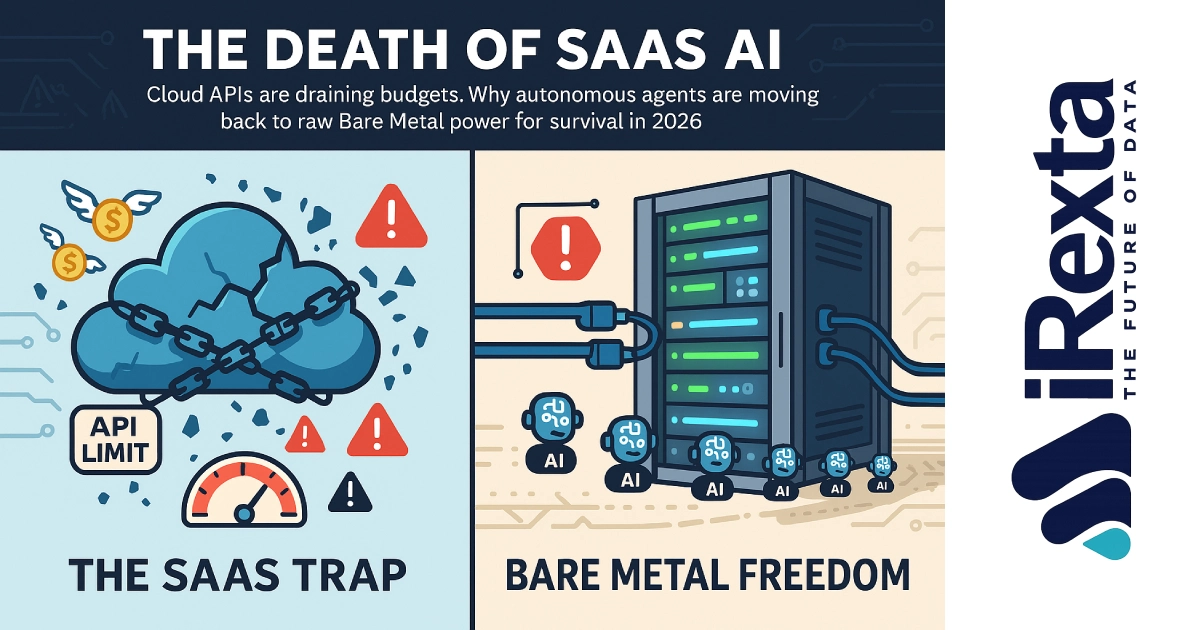
The Death of SaaS: Why AI Agents Are Moving Back to Bare Metal

The Death of SaaS: Why AI Agents Are Moving Back to Bare Metal

AI APIs and Cloud GPUs are draining budgets. Discover why the tech industry is shifting toward Bare Metal Dedicated Servers for running AI Agents in 2026.

Website Bandwidth vs. Data Transfer: The Dedicated Server Guide

Website Bandwidth vs. Data Transfer: The Dedicated Server Guide

Confused by hosting specs? We break down the critical difference between Port Speed (1Gbps) and Monthly Transfer limits so you can stop overpaying for "Unlimited" lies.

VMware is Dead? Switch to Proxmox Bare Metal

VMware is Dead? Switch to Proxmox Bare Metal

Broadcom just broke the contract of trust. Learn why sysadmins are fleeing ESXi for Proxmox, KVM, and ZFS on iRexta Bare Metal.

Why Gaming Companies Are Switching to Bare Metal Servers

Why Gaming Companies Are Switching to Bare Metal Servers

Lag kills games. Discover why top gaming studios choose Bare Metal over Cloud for higher Tick Rates, lower latency, and zero Noisy Neighbors.

TLS vs. SSL: Key Differences & Why You Must Upgrade (2025 Guide)

TLS vs. SSL: Key Differences & Why You Must Upgrade (2025 Guide)

Confused about TLS vs. SSL? Our definitive guide breaks down the critical differences in security, encryption, and performance.

RAID 50 vs RAID 60: Which RAID Configuration Is Best for Your Server Needs?

RAID 50 vs RAID 60: Which RAID Configuration Is Best for Your Server Needs?

Confused between RAID 50 and RAID 60? Discover the key differences, performance comparisons, and best use cases. Learn which configuration suits your server setup in Denver or across Colorado.

Private Networking for Bare Metal Servers

Private Networking for Bare Metal Servers

Discover how private networking for bare metal servers boosts security, reduces latency, and saves bandwidth costs. Learn benefits, use cases, and how it works.

What Are the Risks of Not Having a Dedicated IP Address?

What Are the Risks of Not Having a Dedicated IP Address?

In today's interconnected digital landscape, a dedicated IP address plays a crucial role in ensuring secure, stable, and high-performance access to online services.

What Is the Difference Between SoftRAID and HardRAID? Which One Is Better?

What Is the Difference Between SoftRAID and HardRAID? Which One Is Better?

RAID, short for Redundant Array of Independent Disks, is a foundational technology used in data storage to improve performance, enhance fault tolerance, and ensure high availability.

1