Deepfake Detection Infrastructure Specifications
- Processing Target: 60 Frames Per Second (Zero-Drop)
- Network Requirement: 10Gbps Unmetered (BGP Routing)
- Recommended Hardware: Enterprise Datacenter GPUs (NVIDIA L40S / A100 / H200)
- Cloud VM Risk: High Egress Costs & Shared Hypervisor Latency
Introduction: The 60 FPS Security Crisis
In 2026, cybercriminals do not steal passwords; they clone identities. Modern deepfake attacks occur live during corporate video calls, bypassing traditional MFA (Multi-Factor Authentication). Defeating these attacks requires analyzing high-definition video streams in real-time.
However, security teams are making a fatal architectural mistake. They deploy advanced deepfake detection infrastructure on shared Cloud VMs. This guide exposes why virtualization destroys real-time video analysis and why GPU servers for deep learning are the only impenetrable defense.
The Deepfake Meaning and Definition
The deepfake definition refers to synthetic media where a person's face or voice is digitally altered using artificial intelligence. Cybercriminals use deep learning techniques, such as Generative Adversarial Networks (GANs), to manipulate identity and bypass corporate security protocols.
While the general deepfake meaning implies simple face-swapping for entertainment, the enterprise reality is much darker. Modern identity attacks occur in real-time during live board meetings or financial transactions. Detecting these synthetic anomalies instantly is why traditional CPU-based firewalls are failing, forcing security teams to upgrade to GPU-accelerated infrastructure.
Why Do Cloud VMs Drop Frames During Deepfake Analysis?
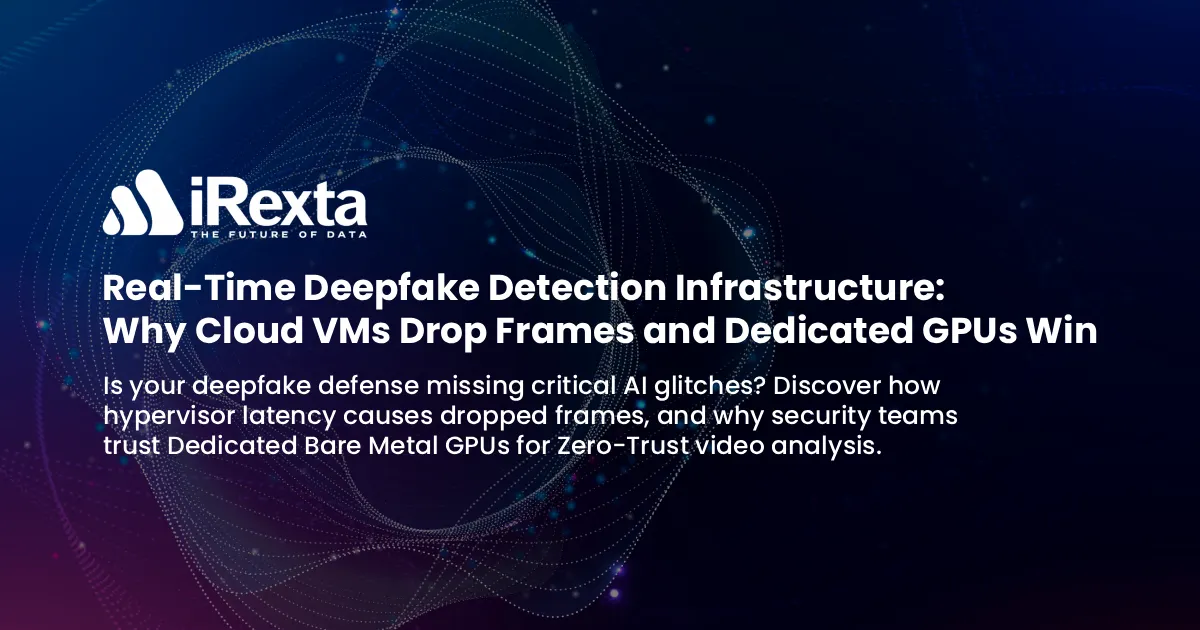
Cloud VMs share physical hardware using a hypervisor. This virtualization layer introduces network latency and vCPU steal time. During real-time 60 FPS video analysis, this latency causes buffer underruns, forcing the system to drop critical video frames where deepfake artifacts hide.
To detect a deepfake, your AI must scan for micro-expressions, unnatural blinking, and synthetic blurring. These artifacts often appear for only 1 or 2 frames (a fraction of a second). If your Cloud VM drops those specific frames due to "noisy neighbors" hogging the shared host, the deepfake attack succeeds.
Deepfake CPU vs GPU: The Math Behind the Bottleneck
Many IT teams attempt to run real-time deepfake analysis on powerful multi-core CPUs. This fails mathematically. A standard 1080p video at 60 FPS requires the system to process over 124 million pixels every second.
- The CPU Limitation: CPUs handle sequential tasks rapidly. They lack the thousands of arithmetic logic units needed to process millions of pixels simultaneously. A top-tier CPU will max out at 5-10 FPS on complex models.
- The GPU Supremacy: GPUs execute massive parallel matrix multiplications. A dedicated graphics card processes the entire video frame simultaneously, achieving the required 60 FPS effortlessly.
| Hardware Architecture | Processing Capability | Best Use Case |
|---|---|---|
| Enterprise CPU | Sequential Processing (Low throughput for pixels) | Offline batch processing of audio deepfakes. |
| Cloud vGPU | Shared Parallel (High latency, frame drops) | Testing and model training (Not real-time). |
| Dedicated Bare Metal GPU | Massive Parallel (Zero latency, 60+ FPS) | Mission-critical real-time deepfake threat defense. |
Deepfake Detection System Requirements: VRAM & NVDEC Engines
Advanced deepfake detection techniques no longer use simple algorithms; they rely on massive Vision Transformers (ViT) and Convolutional Neural Networks (CNNs). Loading these complex neural network weights to analyze high-resolution frames requires immense Video RAM (VRAM) and Tensor Core performance.
However, calculating the AI model is only half the battle. Processing 124 million pixels per second requires dedicated hardware video decoding and ultra-fast pre-processing. Adversaries may generate fakes using consumer hardware like a deepfacelab RTX 4090, but consumer cards feature limited NVDEC (NVIDIA Video Decoder) engines. Furthermore, scaling and normalizing those decoded frames using standard CPU software causes a severe pre-processing bottleneck before the AI even begins scanning.
To instantly counter these threats, security teams must deploy Enterprise Datacenter GPUs (like the NVIDIA L40S, A100, or H200) equipped with multiple independent NVDEC engines and optimized for GPU-accelerated pre-processing libraries like NVIDIA CV-CUDA or DALI. With massive VRAM, parallel hardware decoding, and zero-copy data pipelines, iRexta's dedicated datacenter GPUs can decode, preprocess, and scan multiple live video streams simultaneously, ensuring 24/7 mission-critical stability without a single dropped frame.
For mission critical enterprise deployments, a single GPU is often not enough. To achieve seamless multi-GPU scaling across 4 or 8 accelerator nodes, iRexta utilizes NVIDIA NVLink technology. Unlike traditional PCIe interconnects that choke under heavy synchronization tasks, NVLink allows GPUs to share data at up to 900 GB/s. This high-speed interconnect is essential for distributed deepfake detection infrastructure, enabling your AI models to scale linearly across multiple Enterprise GPUs without inter-node latency.
Beyond Video: Multi-Modal Deepfake Threat Defense
While real-time video cloning is the most visible threat, modern identity attacks are often multi-modal. Cybercriminals increasingly combine synthetic video with deepfake voice cloning to bypass biometric verification and high-level corporate security protocols.
iRexta’s dedicated GPU infrastructure is not limited to processing pixels. Our high-VRAM Enterprise nodes provide the colossal parallel processing power required to run concurrent deepfake audio and photo detection models. Whether it is scanning a static profile deepfake photo for GAN-generated artifacts or analyzing a live audio stream for synthetic speech patterns, our Zero-Trust hardware ensures a comprehensive 360-degree defense against all forms of synthetic media threats.
Deepfake Laws and Cybersecurity Threats
As deepfake threats in cybersecurity escalate, governments are responding rapidly. Emerging deepfake laws and deepfake legislation US mandates strictly regulate how biometric and video data is processed by corporations.
Routing sensitive corporate video feeds through third-party SaaS APIs or shared public cloud deepfake detection tools often violates these new data sovereignty and privacy regulations. By hosting your custom deepfake video detector on iRexta's isolated Bare Metal servers, your organization maintains 100% legal compliance while actively defending against advanced identity spoofing.
The iRexta Solution: Zero-Trust GPU Infrastructure
The ultimate deepfake detection infrastructure, engineered by iRexta, delivers zero frame drops through pure hardware isolation. Sending sensitive corporate video feeds to a public cloud API breaks GDPR and HIPAA compliance. True Zero-Trust requires running your detection models locally.
- Direct PCIe Access: iRexta provisions dedicated GPU servers where your OS has direct, unshared access to the PCIe Gen 4/5 lanes. There is no hypervisor tax.
- 10Gbps for Massive Concurrent Ingestion: Analyzing a single 4K stream is trivial, but enterprise security requires scanning hundreds of live video calls simultaneously (Massive Concurrent Ingestion). iRexta’s 10Gbps unmetered ports provide the colossal bandwidth needed for enterprise-scale monitoring while completely eliminating exorbitant cloud egress fees.
- Hardware-Level Network Isolation: Deploy your defensive deepfake analysis on dedicated Bare Metal. Instead of relying on a shared cloud VPC, your sensitive video data flows through physically dedicated network interfaces, completely isolated from hypervisor vulnerabilities and "noisy neighbor" network congestion.
Conclusion: Stop Missing the Artifacts
A deepfake attack only needs to fool you once to cause catastrophic financial and legal defamation damage. Do not compromise your threat defense by running heavy AI workloads on shared Cloud VMs.
Secure your video streams today. Explore iRexta’s Dedicated GPU Servers for Deep Learning and build an impenetrable Zero-Trust defense.